
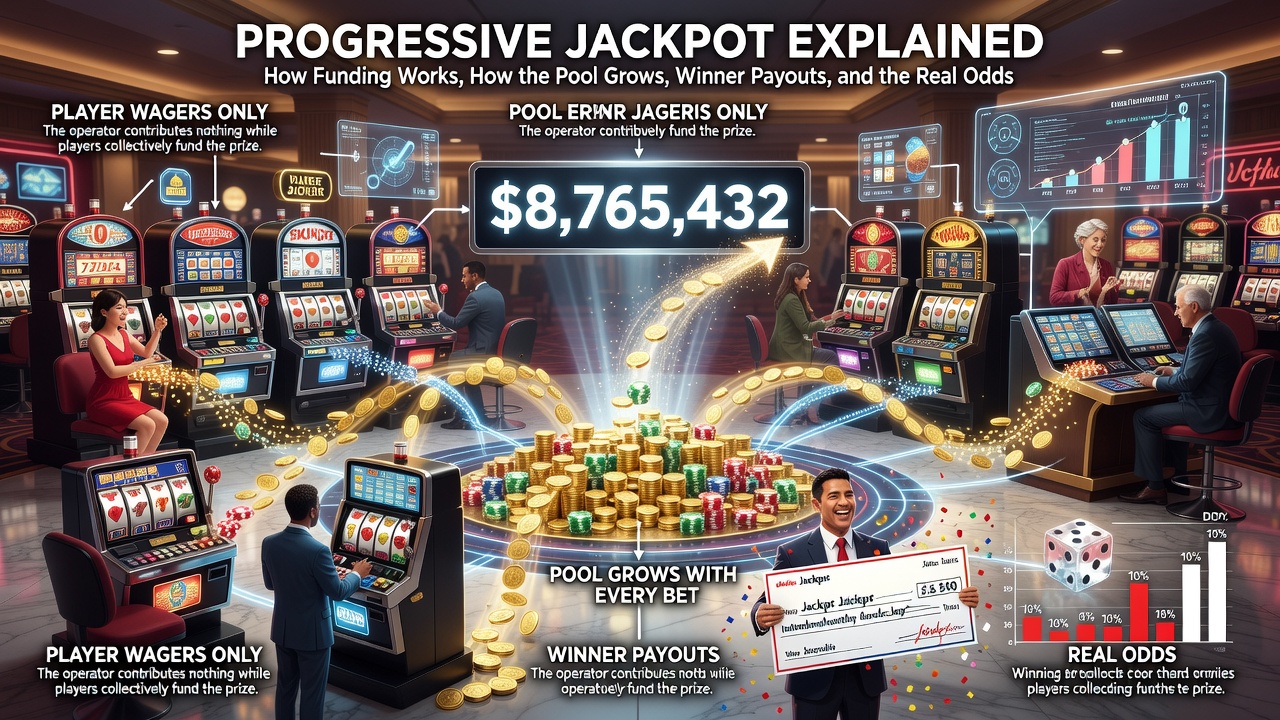
A single progressive jackpot can climb from a few thousand dollars to eight figures without a single dollar coming from the operator's own pocket. That distinction surprises most players. The money that eventually lands in a winner's account was, in fact, contributed by every other player who spun the reels or pulled the lever before the jackpot dropped. Understanding this mechanism changes how you evaluate the game entirely.
Most players treat a progressive jackpot as a mysterious number that grows for reasons nobody bothers to explain. That gap in understanding is exactly why confusion persists around how these prizes are built, funded, and eventually paid. A clear progressive jackpot explanation requires looking at three separate systems working together: the contribution mechanism, the pooling structure, and the payout rules. For readers who want the mechanics laid out precisely, resources like how does a progressive jackpot work offer a technical breakdown worth consulting before you play. The sections below walk through each piece in order, from the first cent added to the pool to the moment a winner's payout actually clears.
By the end, you will know not just how the jackpot number climbs on your screen, but what your realistic odds are of ever seeing it land on yours.
What a Progressive Jackpot Actually Is
The Core Definition
A progressive jackpot is a prize pool that increases over time rather than staying fixed. Unlike a standard jackpot, which pays a set amount regardless of how many people have played, a progressive jackpot grows with every wager placed on the game or network of games connected to it. The number displayed to players updates in near real time, often ticking upward with each qualifying bet placed anywhere in the connected system.
Fixed vs. Progressive Prize Structures
Fixed jackpots pay a predetermined amount the moment the winning condition is met. Progressive jackpots have no ceiling until someone wins, at which point the pool typically resets to a seed value and starts climbing again. This structural difference is what makes progressive jackpots capable of reaching sums that dwarf anything a fixed-prize game could offer.
Where You'll Encounter Them
Progressive jackpots appear most commonly in slot machines, both physical and digital, but they also show up in certain table game variants and lottery-style products. The underlying principle stays consistent across formats: a portion of every stake feeds a pool that keeps growing until it pays out.
How Progressive Jackpots Are Funded
The Contribution Mechanism
Every time a player places a bet on a game linked to a progressive jackpot, a small fraction of that wager is diverted into the jackpot pool. This is the foundation of how progressive jackpots are funded: the prize is not manufactured by the operator but assembled gradually from the collective betting activity of everyone playing the connected games. The percentage taken from each bet is usually small, often a fraction of a percent, but across thousands of simultaneous players, that fraction accumulates fast.
Standalone vs. Networked Funding Models
There are two broad funding structures. A standalone progressive draws contributions only from players on that single machine or game, which means it grows more slowly but pays out more often. A networked or linked progressive pools contributions from many machines, sometimes across multiple venues or platforms, which produces the massive jackpot figures that grab headlines but also stretches the odds of winning considerably thinner.
Who Actually Pays for the Prize
This is the point most players misunderstand. The operator does not fund the jackpot from its own margins. Players fund it collectively, bet by bet. The house's role is to manage the mechanism, guarantee the payout when it triggers, and take its own cut from the base game separately from the jackpot contribution.
- A fixed percentage of each wager is allocated to the jackpot pool
- Standalone machines fund jackpots independently, with slower growth
- Networked systems combine contributions across many machines for larger prizes
- The base wager still funds the standard game payouts separately
How the Jackpot Pool Grows
The Contribution Rate
Jackpot pool contributions typically range between roughly one and two percent of each wager, though the exact figure varies by game and operator. That rate is calibrated carefully: too high, and the base game becomes unprofitable for the house; too low, and the jackpot grows too slowly to attract attention. Game designers balance this rate against expected play volume to keep growth visible without destabilizing the overall payout structure.
Volume as the Real Growth Driver
The speed at which a jackpot climbs has less to do with the contribution percentage and more to do with how many people are playing. A jackpot linked to a popular game with thousands of active players will grow visibly within hours. A niche title with a small player base might take weeks to move the same amount. This is why the most eye-catching progressive jackpots tend to be attached to widely played, heavily marketed games.
Seed Values and Reset Mechanics
After a jackpot is won, it does not drop to zero. It resets to a seed value, a baseline amount set by the operator to keep the game attractive even immediately after a payout. From that seed, contributions begin accumulating again, restarting the growth cycle.
How Winners Share Progressive Jackpots
Single Winner vs. Split Scenarios
In most slot-based progressive systems, one player triggers the jackpot and receives the full amount. But certain formats, particularly those built around shared prize pools or specific triggering conditions across multiple players, distribute the prize differently. Understanding how winners share progressive jackpots matters most in games explicitly designed around pooled or tiered prize structures, such as multi-tier progressives with separate mini, major, and grand jackpot levels.
Tiered Jackpot Structures
Many modern progressive systems don't offer just one jackpot level. They split contributions across two, three, or four tiers, each with its own odds and payout size. A small percentage of the contribution feeds a frequently won minor prize, while a smaller fraction feeds the grand prize that might take months to hit. This tiered approach keeps players engaged with regular smaller wins while the headline jackpot continues climbing in the background.
Lump Sum vs. Annuity Payments
Large jackpots, particularly those tied to lottery-style progressives, often give winners a choice between a reduced lump sum paid immediately or the full advertised amount distributed over a series of annual payments. The lump sum is always smaller than the annuity total because it reflects the present value of money paid over time rather than all at once. Slot-based progressives, by contrast, usually pay the full amount in a single transaction once verification is complete.
Progressive Jackpot Odds and Payouts
Why the Odds Are Steeper Than Standard Wins
Progressive jackpot odds and payouts sit at the extreme end of the probability spectrum. Because the prize pool draws from potentially thousands of machines or players simultaneously, the odds of triggering the top-tier win on any individual spin are dramatically lower than hitting a standard combination on the same game. Some networked progressives carry odds comparable to major lottery draws, sometimes in the range of one in several million.
Return-to-Player Considerations
Games with progressive jackpots often display a lower base return-to-player percentage than non-progressive equivalents, because a slice of every wager is diverted into the jackpot pool rather than being returned through regular payouts. The jackpot itself compensates for this over the long run, but only for the rare player who actually wins it. For everyone else, the effective return is slightly reduced compared to a non-progressive version of the same game.
Reading the Real Probability Behind the Marketing
Advertised jackpot sizes are designed to attract attention, but they say nothing about your actual chance of winning. A ten-million-dollar jackpot with odds of one in fifty million offers a dramatically different expected value than a two-hundred-thousand-dollar jackpot with odds of one in two million. Comparing the advertised prize size without checking the corresponding odds gives an incomplete and often misleading picture.
Practical Considerations Before You Play
Checking Jackpot Rules and Terms
Before playing any progressive game, check whether the jackpot requires a maximum bet to qualify. Many progressive slots only make you eligible for the top prize if you're wagering at or near the maximum stake, which significantly changes the cost-to-odds calculation for casual players.
Balancing Entertainment Value Against Expected Loss
Progressive jackpots are, statistically, a long-shot bet layered on top of a game you're already playing. Treating the jackpot chase as entertainment rather than a viable income strategy keeps expectations aligned with reality. The base game's standard payouts should be the primary reason for play; the jackpot is a bonus possibility, not a plan.
Frequently Asked Questions
Does a bigger jackpot mean better odds of winning it?
No. A larger jackpot usually means more players have been contributing to it over a longer period without anyone winning, which says nothing about your individual odds on any given spin. Larger networked jackpots typically carry harder odds precisely because more machines are pooling into the same prize.
Do I need to bet the maximum amount to qualify for a progressive jackpot?
On many slot machines, yes. A significant number of progressive games restrict jackpot eligibility to players wagering the maximum bet per spin, even though smaller bets still contribute a fraction to the pool. Always check the game's rules panel before assuming you're eligible.
What happens to the jackpot pool if a machine is taken offline?
For standalone machines, the accumulated jackpot amount is generally preserved and either transferred or reset according to the operator's policy. For networked progressives, the pool continues growing from contributions on other connected machines regardless of any single unit going offline.
Are progressive jackpot odds the same across every casino offering the same game?
Not necessarily. Even identical game titles can be configured with different contribution rates or connected to different-sized networks depending on the platform, which affects both the growth rate and the odds of triggering the top prize.
Is it true that jackpots are more likely to hit after reaching a certain size?
No. Each qualifying spin has an independent probability of triggering the jackpot, unaffected by how large the pool has grown or how long it's been since the last win. This is a common misconception rooted in gambler's fallacy reasoning, not in how the underlying random number generators actually function.
Can multiple players win a progressive jackpot at the same time?
On most single-tier slot jackpots, only one player can trigger the win at a time, since the prize resets immediately after payout. In tiered or networked formats, however, it's possible for different players to hit different jackpot levels close together, since each tier operates on its own independent trigger condition.