
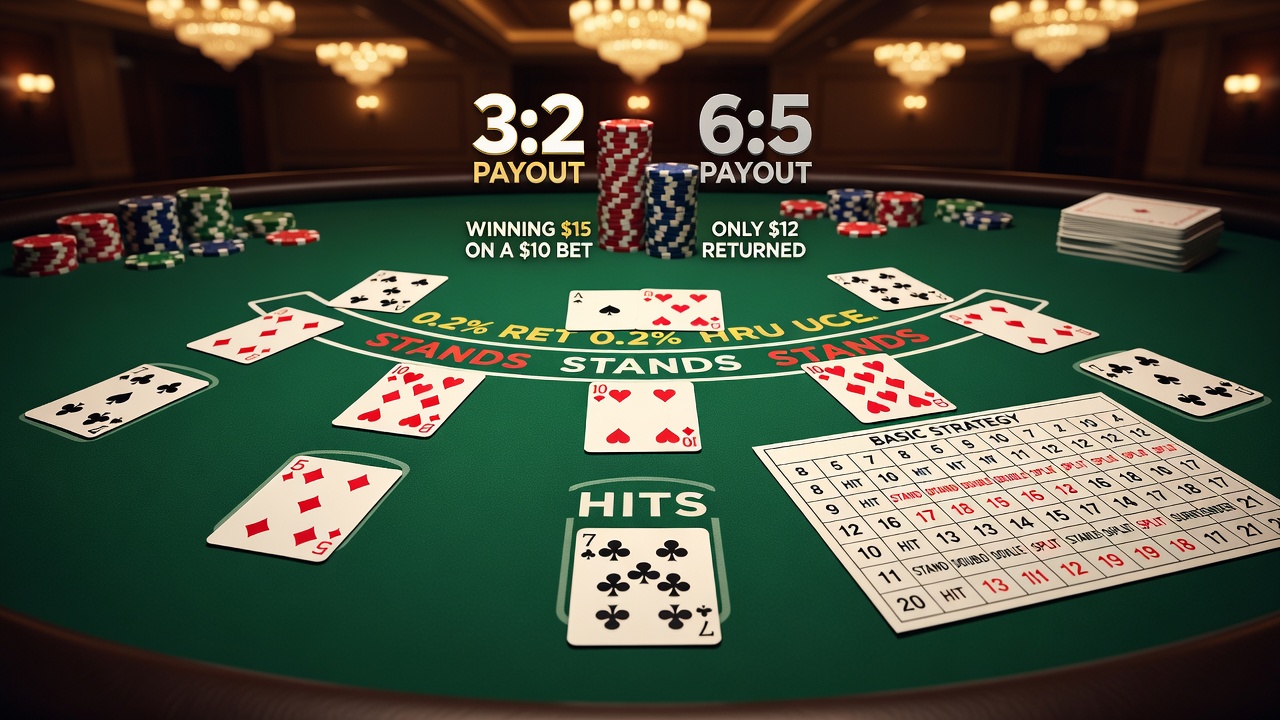
A single word printed on a blackjack table felt - "stands" versus "hits" - can shift the house edge by roughly 0.2 percent. That fraction sounds trivial until you realize it separates a mathematically sound game from one quietly stacked against you. Casinos know this. Most players don't. The gap between those two groups is exactly where blackjack rules stop being fine print and start being the difference between a manageable loss rate and a slow bleed of your bankroll.
Blackjack looks simple from a distance: get closer to 21 than the dealer without busting. But the mechanics underneath - how payouts are calculated, when insurance is offered, whether the dealer stands or hits on soft totals - determine the actual odds you're playing against. Table variations aren't cosmetic. A shift from a 3:2 payout to 6:5, for instance, inflates the house edge dramatically, and few casual players notice until they've already sat down. If you want to understand how side rules like doubling after a split affect your options, the das rule blackjack reference is a useful starting point before diving into strategy charts. Small print changes everything.
This guide walks through the rules that actually matter: how the game is scored, how it pays, why the dealer's 17 policy reshapes your decisions, and how basic strategy converts all of this into a repeatable, disciplined approach. No myths, no superstition - just the mechanics that govern every hand dealt.
Understanding the Core Blackjack Rules
Objective of the Game and Card Values
Blackjack's target is straightforward: build a hand worth more than the dealer's without exceeding 21. Number cards count at face value, face cards count as 10, and the ace flexes between 1 and 11 depending on what benefits the hand. This flexibility is why a hand containing an ace is called "soft" - it can't bust on the next card the way a "hard" total can.
Table Setup and Betting Sequence
Each round starts with players placing wagers before any cards are dealt. The dealer gives two cards to each player and two to themselves, typically with one dealer card face up. Action moves left to right, with each player deciding to hit, stand, double, split, or surrender before the dealer reveals their hole card and plays out their own hand according to fixed rules.
Common Table Variations Players Should Recognize
Not every blackjack table plays identically. Number of decks, whether surrender is allowed, and how doubling is restricted all vary by casino and even by shift. Recognizing these differences before you sit down protects you from unknowingly choosing a worse game.
- Single-deck vs. multi-deck shoes, which affect card-counting feasibility and edge
- Early or late surrender availability
- Doubling restrictions on specific totals only
- Re-splitting limits, including whether aces can be re-split
Blackjack Payout Rules Explained
Standard 3:2 Payouts and Why They Matter
A natural blackjack - an ace plus a 10-value card on the first two cards - traditionally pays 3:2. Bet ten dollars, win fifteen. This ratio has been the industry standard for decades because it balances the house's edge with player return in a way that keeps the game sustainable for both sides.
The 6:5 Shift and Its Real Cost
Some tables, often ones with lower minimums or faster single-deck games, pay blackjacks at 6:5 instead of 3:2. Bet ten dollars, win only twelve. This seemingly minor adjustment increases the house edge by more than a full percentage point, which is enormous in a game where skilled players routinely operate near even odds. Avoiding 6:5 tables is one of the simplest ways to protect your bankroll.
Push, Bust, and Even-Money Payouts
When a player and dealer tie, the hand is a push and the original bet returns with no gain or loss. Regular wins - beating the dealer without a natural - pay even money, 1:1. Busting, regardless of the dealer's outcome, forfeits the bet immediately, which is why dealers collect busted hands before finishing their own play.
How Dealer Stands on 17 Changes the Game
Soft 17 vs. Hard 17: What the Distinction Means
A hard 17 has no ace, or an ace counted as 1 - there's no flexibility. A soft 17 includes an ace counted as 11, such as ace-6. The distinction matters because casino rules specify exactly how the dealer must act on each.
Rules Where the Dealer Stands on 17
In many casinos, the dealer stands on all 17s, hard or soft. This is generally the more favorable rule for players because it removes one avenue for the dealer to improve a weak hand. When the dealer must stand on soft 17, the house edge drops slightly compared to tables where the dealer hits.
Rules Where the Dealer Hits Soft 17
Other tables require the dealer to hit on soft 17, giving them another chance to reach a stronger total. This single rule difference, often abbreviated H17 versus S17 on strategy charts, shifts the house edge by roughly 0.2 percent - enough that serious players actively seek out S17 tables when given a choice.
Blackjack Insurance Rules and Side Bets
What Insurance Actually Covers
When the dealer's face-up card is an ace, players are offered insurance - a side bet, usually half the original wager, that pays 2:1 if the dealer has blackjack. It's technically a wager on whether the dealer's hole card is a 10-value card, independent of your own hand's strength.
Why Insurance Is Usually a Losing Proposition
The math rarely favors taking insurance. In a standard multi-deck shoe, the probability that the dealer's hole card is a 10-value card is below the threshold needed to make insurance profitable long-term. It's a bet built on incomplete information, and basic strategy charts almost universally advise against it unless a player is actively counting cards and knows the deck is rich in high cards.
Even Money as a Variant of Insurance
When a player holds a natural blackjack and the dealer shows an ace, the dealer may offer "even money" - guaranteeing a 1:1 payout instead of risking the hand resulting in a push against a dealer blackjack. This is mathematically identical to taking insurance on a winning hand, and the same logic against insurance applies here.
Blackjack Basic Strategy Rules
Why Basic Strategy Exists
Basic strategy is a set of decisions - derived from probability calculations across millions of hand simulations - that tells a player the statistically correct action for every combination of their hand and the dealer's up card. It doesn't guarantee winning any single hand, but it minimizes the house edge over time.
Reading a Basic Strategy Chart
Charts are organized by player total along one axis and dealer up card along the other. Each cell tells you whether to hit, stand, double, split, or surrender. The chart changes slightly depending on table rules - whether the dealer stands on 17, whether surrender is allowed, and how doubling and splitting are restricted.
Adjusting Strategy for Rule Variations
A chart built for a game where the dealer hits soft 17 differs from one built for a stand-on-17 game. Players who memorize a single chart and apply it universally are quietly giving back some of their edge. Matching your strategy sheet to the exact table rules you're playing is not optional if you want the lowest possible house edge.
Common Strategy Mistakes Players Make
Even experienced players fall into predictable traps: standing too early on soft hands, failing to double down on strong totals against weak dealer cards, or splitting pairs that basic strategy says to keep together. These errors compound over hundreds of hands and are almost always avoidable with a memorized chart.
- Not splitting 8s against a dealer's strong up card
- Standing on hard 16 instead of taking the statistically correct hit
- Failing to double on 11 against a dealer's low card
- Ignoring surrender options when clearly favorable
Putting the Rules Together at the Table
Evaluating a Table Before You Sit Down
Before placing a single chip, check the payout ratio, whether the dealer stands or hits on soft 17, and what doubling and splitting restrictions apply. These three factors alone tell you most of what you need to know about a table's overall fairness.
Combining Rule Knowledge with Strategy Discipline
Rules and strategy work together, not separately. Knowing that a table pays 3:2 and stands on all 17s is only useful if you then apply the correct basic strategy chart for that exact configuration. Players who understand the rules but ignore strategy - or vice versa - leave measurable value on the table.
Frequently Asked Questions
Does the number of decks in play affect the house edge?
Yes. Fewer decks generally lower the house edge slightly because the probability of specific card combinations shifts in the player's favor. Single-deck games, when paired with favorable payout and dealer rules, offer some of the best odds available, though they're increasingly rare.
Is it ever correct to take insurance?
Under standard conditions, no. Insurance only becomes statistically favorable when a player has verified, through card counting, that the remaining deck is unusually rich in 10-value cards. For the average player relying on basic strategy alone, insurance should be declined every time it's offered.
Why do some casinos use 6:5 payouts instead of 3:2?
Casinos adopt 6:5 payouts to increase their edge, particularly on tables designed for faster play or lower stakes. It generates more revenue per hand for the house without changing the visible rules of hitting, standing, or splitting, which is exactly why many players overlook it.
Does doubling after split really make a meaningful difference?
It does. Allowing players to double their bet after splitting a pair adds flexibility that lowers the house edge measurably compared to tables that prohibit it. This is one of several rule variants worth checking before choosing a table.
Can basic strategy guarantee winning sessions?
No strategy guarantees short-term results, since blackjack still involves genuine randomness hand to hand. What basic strategy guarantees is the mathematically lowest possible house edge over a large number of hands, turning blackjack into one of the most favorable games in a casino when played correctly.
How does the dealer's soft 17 rule affect which strategy chart I should use?
Charts built for hit-soft-17 tables recommend slightly more aggressive doubling and standing decisions on certain totals compared to stand-on-17 charts. Using the wrong chart for the table's actual rule set introduces small but consistent errors that add up over time.