
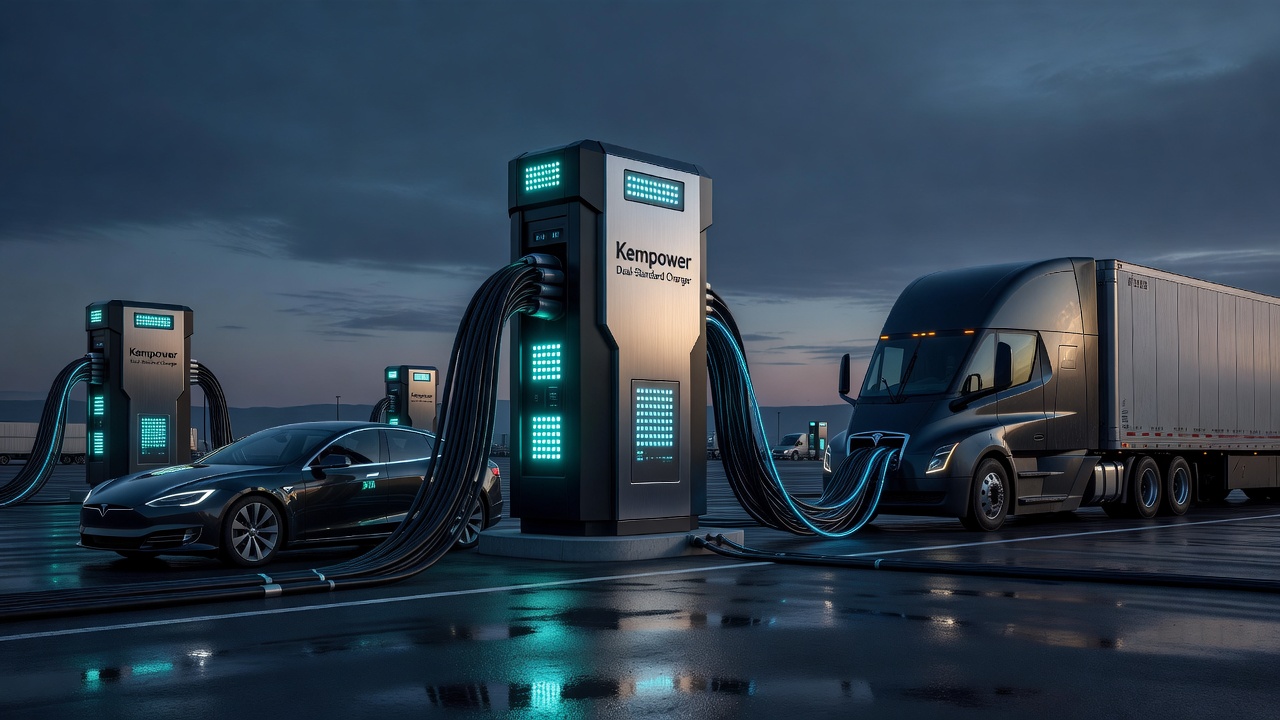
Kempower has introduced a single charging unit capable of serving both passenger electric vehicles and heavy-duty trucks, a design choice that could reshape how charging sites are planned and built. The new Mega Satellite Flex supports the established CCS standard at up to 560 kW and the emerging Megawatt Charging System (MCS) at up to 1.2 MW, making it the company's first dispenser to offer both options in one unit. The announcement came this week at ACT Expo, during Kempower's Unplug & Recharge event for customers and partners.
Why One Charger for Two Vehicle Classes Matters
The electric vehicle charging industry is at an awkward junction. CCS remains the dominant standard for cars and light commercial vehicles, while MCS is only now being deployed to meet the far higher power demands of electric trucks, which need to recharge large battery packs quickly to stay commercially viable. Building separate infrastructure for each standard has meant duplicated costs, land use, and grid connections. By combining both into one dispenser, Kempower is betting that site owners will avoid a second, costlier buildout down the road. That's a meaningful consideration for network operators trying to plan sites that remain useful as vehicle fleets shift toward higher-voltage architectures - and for drivers who want consistent charging performance, understanding what throttling looks like and how to spot it on their vehicle's charging curve can help clarify whether slower sessions stem from the vehicle, the charger, or grid conditions.
Technical Specifications and Site Flexibility
The Mega Satellite Flex is built to handle demanding electrical loads. It supports up to 1,500 amps for MCS sessions and 700 amps for CCS, with cable lengths of 5 meters for CCS and 2.7 meters for MCS - long enough to accommodate varying truck and car geometries without forcing awkward parking maneuvers. An optional payment terminal allows the unit to function as a standalone commercial charging point rather than requiring a separate kiosk. Because it integrates with Kempower's existing distributed charging architecture, operators already running Kempower hardware can add the Mega Satellite Flex without redesigning their entire site.
What This Signals for the Charging Market
The unit's compatibility with 800-volt vehicle platforms is a notable detail. Newer EVs built on higher-voltage architectures can draw power faster, cutting charging times meaningfully compared with older 400-volt designs. A charger that can serve both today's 400-volt fleet and tomorrow's 800-volt vehicles, plus heavy trucks on MCS, gives operators a longer usable lifespan for their capital investment. That flexibility directly affects utilization rates - a charger sitting idle waiting for the right vehicle type generates no revenue, so serving a broader mix of vehicles from a single pad improves the economics of every site.
Timeline and Market Rollout
Kempower expects the Mega Satellite Flex to reach North America and Europe in July 2026, giving fleet operators and charging network developers over a year to plan deployments. That timeline aligns with broader infrastructure buildouts tied to freight electrification targets in both regions, where regulatory pressure and corporate fleet commitments are pushing logistics companies toward electric trucks faster than public charging infrastructure has historically kept pace.